
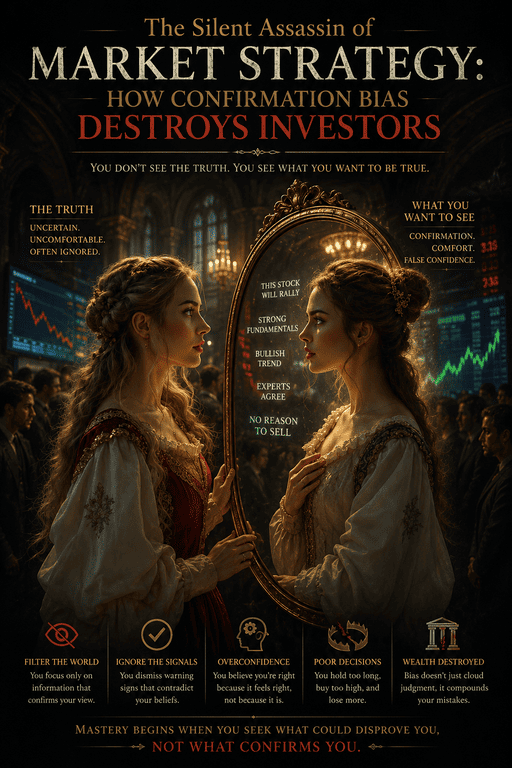
The Psychology of Crowds: Why Markets Move Before the Crowd Understands Why
Markets are often presented as machines governed by earnings, interest rates, inflation and economic data. Those forces matter, but they do not operate independently because every fact must first pass through human expectations before it becomes financial action. That is why mass psychology sits beneath almost every major market movement.
A strong earnings report can produce a decline when investors expected something even better, while terrible economic news can trigger a rally when the crowd had already positioned for disaster. Markets do not react mechanically to facts; they react to the difference between reality and expectation. Fear, greed, imitation, overconfidence and panic have driven that process for centuries, while technology has merely accelerated the speed at which collective emotion spreads.
Mass psychology therefore connects the broader structure. Fundamentals provide context, technical analysis measures price behaviour, liquidity reveals how much fuel remains in the system and sentiment exposes positioning, but none of these tools operates outside human perception.
Vector Analysis: Understanding the Direction of Psychological Pressure
Vector analysis adds another layer by examining not merely whether investors are fearful or greedy, but whether those emotions are gaining or losing force. A market can continue falling while the psychological pressure behind the decline weakens, just as a market can continue rising while optimism becomes increasingly fragile.
When bad news repeatedly produces less selling, or good news produces progressively weaker rallies, the visible trend and the underlying psychological pressure may no longer be moving together. That divergence matters because one of the most useful signals is often not what is happening, but what has stopped working.
A market may remain surrounded by negative headlines while becoming increasingly resistant to further declines, whereas an apparently powerful rally may begin requiring ever more enthusiastic buyers simply to maintain momentum. Price alone tells only part of the story; the changing reaction to information can reveal whether the emotional forces driving the trend are strengthening or becoming exhausted.
The Dollar Is Only One Piece of the Psychological Puzzle
The endless debate surrounding the death of the United States dollar illustrates this principle perfectly. For years, investors have repeatedly been told that the dollar is finished and that another currency or financial system will inevitably replace it. The argument may eventually prove correct, but popularity alone does not make a narrative investable.
When a belief becomes widespread, the observer must ask what expectations and positioning already exist behind it. If everyone expects the same outcome, much of that expectation may already be reflected in market positioning, creating vulnerability if reality fails to cooperate.
The dollar is therefore only one piece of a much larger puzzle. The same mechanism operates in stocks, bonds, commodities and cryptocurrencies. An asset does not become dangerous simply because optimism exists; risk rises when optimism becomes crowded and psychologically universal. Likewise, terrible news does not automatically create opportunity, but extreme fear can distort the relationship between perception and value.
The crowd sees the narrative. The observer studies the positioning behind it.
How Narratives Become Financial Weapons
Human beings need explanations, which is why narratives become so powerful during major market movements. Rising prices attract attention, attention creates confidence and confidence attracts additional buyers until the narrative appears to validate itself. Declines work in reverse as falling prices generate fear, fear encourages selling and selling creates demand for increasingly alarming explanations.
Eventually, the crowd begins reacting not only to information, but to its own reaction to information.
This feedback loop explains why bubbles and panics can become so extreme. During an advance, confidence feeds confidence until increasingly optimistic assumptions are required to justify existing prices. During a decline, fear feeds fear until investors begin treating every development as confirmation that disaster is inevitable.
The facts may matter, but the crowd’s interpretation of those facts often determines the immediate direction of price.
Liquidity Extends the Psychological Cycle
Liquidity can extend these cycles far beyond what rational analysis might suggest. Greed, speculation and leverage can continue expanding while money remains plentiful, but conditions can change rapidly when liquidity tightens and participants begin protecting gains.
The same leverage that amplified confidence then amplifies fear. That is why markets can reverse with far greater speed than investors expect. Participants who felt comfortable taking increasingly aggressive risks during an advance can suddenly become desperate to reduce exposure when conditions deteriorate. The crowd does not need to become rational for this process to occur; it simply needs to become afraid.
This psychological cycle remains remarkably consistent throughout market history because human nature remains remarkably consistent. Fear removes weak positioning, recovery restores confidence, confidence encourages risk-taking and excessive risk-taking eventually creates vulnerability.
Technical Analysis Should Measure Psychology, Not Replace It
Technical analysis becomes considerably more useful when treated as part of a broader psychological framework rather than as an independent religion. Indicators cannot explain why crowds panic or why greed becomes contagious, but they can help measure how price responds to those emotional conditions.
The strongest approach seeks convergence between several forces. Mass psychology identifies the emotional environment, vector analysis examines whether emotional pressure is strengthening or weakening, technical analysis measures price behaviour, liquidity reveals the availability of financial fuel and fundamentals provide structural context. No single measurement deserves to be worshipped and The objective is convergence rather than certainty.
When sentiment becomes extremely negative, technical pressure reaches an extreme and fundamentally sound assets begin stabilising despite continued bad news, the risk-to-reward equation may begin improving. The investor does not need to identify the exact bottom because that obsession is itself another psychological trap.
The more practical objective is to recognise when collective emotion has travelled too far in one direction while the forces behind that movement begin weakening.
The Real Edge Is Seeing the Crowd Without Becoming Part of It
Every investor believes he is independent until money becomes involved. Fear makes selling appear intelligent, greed makes chasing appear rational and strong trends make caution appear foolish. The greatest challenge is therefore not finding information, because modern investors already have access to more information than they can properly process.
The real challenge is maintaining enough psychological distance to interpret information without becoming emotionally absorbed by it.
Artificial intelligence, algorithms and social media will continue accelerating information and emotional contagion, but they will not eliminate mass psychology. If anything, they may intensify it by allowing narratives, fear and euphoria to spread faster through increasingly connected financial systems.
The dollar is not separate from mass psychology. Stocks, commodities, currencies and technological revolutions are not separate from it either because every financial decision eventually passes through the human filter of expectation, fear, greed and collective belief.Mass psychology identifies the emotional environment. Vector analysis studies the direction and force of that emotion. Technical analysis measures the market’s response.
Together, they do not provide certainty, nor should they. Their value lies in perspective. The investor’s task is to watch the crowd without automatically following it, particularly when the narrative becomes loudest and the psychological pressure beneath the visible trend begins moving in another direction. That is where the real work begins.